The structure of purchasing expenditures is dominated by suppliers in the areas of real estate, IT and administration. The spectrum of supplies is wide, i.e., from comprehensive orders in the area of information technology and consulting to conventional goods and services.
Norms and standards
The PZU Group conducts business activity in compliance with all laws, health and safety rules, human rights and health protection. With its implemented measures, it contributes to shaping the attitudes of suppliers.
Procurement Policy
The Procurement Policy in the PZU Group lays down the fundamental principles in the process of selecting the suppliers of goods and services, and the principles of cooperation and information exchange in procurement the PZU Group. It is in force in all PZU Group companies that are parties to the Agreement on the principles of cooperation within the PZU Group dated 21 March 2017, including: PZU Zdrowie, LINK4, TUW PZUW, TFI PZU, PTE PZU, PZU Pomoc, PZU Centrum Operacji and the PZU Group companies in the Baltic Countries and Ukraine. Bank Pekao and Alior Bank have entered into a cooperation agreement with PZU on cooperation in procurement. Its subject matter is to cooperate for the purpose of achieving procurement-related synergies, exchange information about the supplier market and key variable contractual terms as well as cooperate in the area of procurement procedures, processes and tools.

The document also empathizes the need to store documentation for the entire period of cooperation, to ensure suppliers’ acceptance of the CSR Code and to introduce clauses that allow the transfer of contract information to PZU.
Other important provisions of the Policy require defining rules for cooperation and information exchange between entities within the Group, including the obligation to provide data on purchasing processes and suppliers to the Purchasing Department.
Supplier management procedure
PZU and PZU Życie have in place a Supplier Management Procedure governing the area of supplier registration, verification and qualification. In line with the Procedure, the placement of a supplier on the List of Qualified Suppliers is preceded by supplier registration, verification and qualification processes.
The supplier registers in the Supplier Database at its own initiative or in response to an invitation from a PZU employee if the supplier has not yet been placed on the List of Qualified Suppliers. It fills out the form with the data and submits declarations that it has familiarized itself and accepted the Code of Conduct and ESG Best Practices for PZU Group’s Suppliers.
An employee of the PZU Supplier Qualification and Assessment Team checks the data and documents presented in the form, collects opinions within the organization. Then he or she decides on whether to reject a Supplier or commence its qualification process.
Involves an assessment of the collected data or documents against a specific procurement category. The qualification decision is made by the employee and approved by the manager.

Supplier selection procedure

The “Procedure for the Selection of Suppliers of Goods and Services” defines the principles and method of running the supplier selection procedure in PZU and PZU Życie.
- tender proceedings;
- negotiations;
- single-source procurement.
Documentation related to the supplier selection process, including: requisitioning, invitations to participate in tender proceedings and other tender documents, submitted offers, documents related to the decision-making process of the tender commission or negotiation team and the supplier selection protocol is stored by the Procurement Department or the unit of the company unilaterally making the selection for at least the entire term of cooperation with the selected supplier, and then is archived according to the principles in force in the company. The Procurement Department has the right to verify a requisition in terms of the expedience of a procurement and the description of the subject matter of the procurement.
| Supplier Status | 2024 | 2025 |
|---|---|---|
| Purchasing procedures completed by the Purchasing Department (tenders, negotiations, single-source procurements, requests for information – RFIs) at PZU and PZU Życie. | 299 | 288 |
| Contracts executed with suppliers in PZU and PZU Życie, in total. | 9,646 | 8,124 |
Code of Conduct and Good ESG Practices of the Suppliers of the PZU Group

Conducting business in accordance with these principles and promoting the Code’s values constitute an important criterion for evaluating potential business partners. Moreover, when suppliers submit their offers, they must sign the declaration that they have familiarized themselves with and accepted the Code. The Code defines requirements for suppliers in the areas of environment, society and corporate governance.
The PZU Group expects Suppliers to respect human rights, which includes expecting them to:
- ensure safe and ergonomic working conditions for employees;
- guarantee fair wages and respect the right to freedom of association;
- show zero tolerance to any form of slavery and forced labor;
- comply with the applicable regulations prohibiting child labor;
- ensure the development of employee competences;
- take care of work-life balance;
- ensure equal treatment in the workplace and refrain from any discriminatory practices due to age, gender, disability or race;
- strictly prohibit workplace harassment and any other forms of bullying
The PZU Group expects Suppliers to comply with environmental and climate change mitigation rules, which includes expecting them to:
- strive to recycle secondary raw materials, reduce waste production, and segregate waste that has already been produced;
- minimize the emissions of greenhouse gases, exhaust and dust;
- consume electricity and heat rationally;
- strive to use energy from renewable sources;
- participate in actions for environmental protection and biodiversity restoration;
- promote pro-environmental attitudes.
The PZU Group expects Suppliers to comply with the highest standards of data protection, and
- apply the highest business standards in terms of the principles of fair and free competition and accuracy and credibility in communication with clients;
- adhere to the rules arising from the anti-corruption standards, as laid down in the PZU Group;
- protect and not disclose confidential information obtained in the course of cooperation;
- prevent conflicts of interest;
- respect the intellectual property, moral and property rights of copyright holders.
Prevention of corruption and conflicts of interest
The Code of Conduct and ESG Best Practices for PZU Group’s Supplier deals with the prevention of corruption and conflicts of interest. Suppliers are also obliged to act in this regard by prohibiting the giving or offering of undue benefits to anyone in exchange for a specific action or failure to do so. A Supplier that respects the Code avoids and prevents situations conducive to the emergence of conflicts of interest, both in the process of applying for cooperation with the PZU Group and during the subsequent course of cooperation.
Corruption risk assessment is a constant part of the procurement process. Each potential supplier is subject to corruption risk assessment on the basis of a pertinent risk assessment questionnaire. In addition, in accordance with the Anti-Corruption Program of PZU SA and PZU Życie, each cooperation agreement between PZU and a business partner should comprise anticorruption clauses. One of the clauses is a confirmation of acceptance of the anti-corruption standards prevailing in PZU by the supplier. In accordance with the internal procedures, entities cooperating with PZU and PZU Życie are informed about the Anti-Corruption Program in place in the company.
In every procurement process, PZU employees who are members of procurement teams are informed about the Rules for managing conflicts of interest, the AntiCorruption Program, and the need to report to the relevant PZU units when the possibility of a conflict of interest is identified.
Notwithstanding the above, the senior management involved in the purchasing process makes representations regarding business and personal relations with the supplier recommended in a given procurement procedure.
The Supplier Audit Team administers business audits on suppliers who have concluded an agreement with PZU or PZU Życie or with both companies and on the PZU Group’s prospective business partners. Supplier audits are carried out in compliance with specific priorities and criteria.
- periodic – their purpose is to regularly check suppliers with which PZU Group cooperates. They are conducted according to a predetermined plan;
- ad hoc audits – they are done under order, e.g. in a situation in which a given supplier needs to be checked urgently on account of problems encountered during collaboration or as part of checking a new supplier.
A supplier audit may be conducted in a fundamental scope. In that case it encompasses a diagnosis of the supplier utilizing information from inside and outside the organization, a remote audit using an abbreviated audit form filled out by the supplier and the entire process is wrapped up by drafting a final report and a possible list of recommendations. An extended audit includes an on-site audit in the supplier’s premises. The full audit form filled out on site or directly after the visit is utilized in this type of audit. A representative of the substantive unit may also participate in an extended audit. In both cases, the subject matter of the audit covers, among other issues, topics related to data protection, including personal data protection and environmental protection in the context of waste management. Since 2022, the audits also have covered topics related to human rights, employee rights and environmental protection in terms of energy management, water management and production management.
The ESG area has been mandatory as part of supplier audits since 2023. Appropriate audit recommendations may be made if a supplier is found to commit serious violations or fails to comply with required standards of respecting human rights or the environment. Based on these standards, a mitigation plan for the risks as identified may be prepared, implemented and monitored.

Code of Conduct and
ESG Best Practices for PZU Group’s Suppliers
PZU Group’s network of repair shops
The PZU Group maintains the largest network of auto body and paint shops in Poland, providing comprehensive motor vehicle damage services. The network is managed by PZU Pomoc, which is responsible for its development, supervision and negotiation of cooperation terms. The repair shops operate under B2B contracts and include both authorized dealer service centers and independent repair shops.
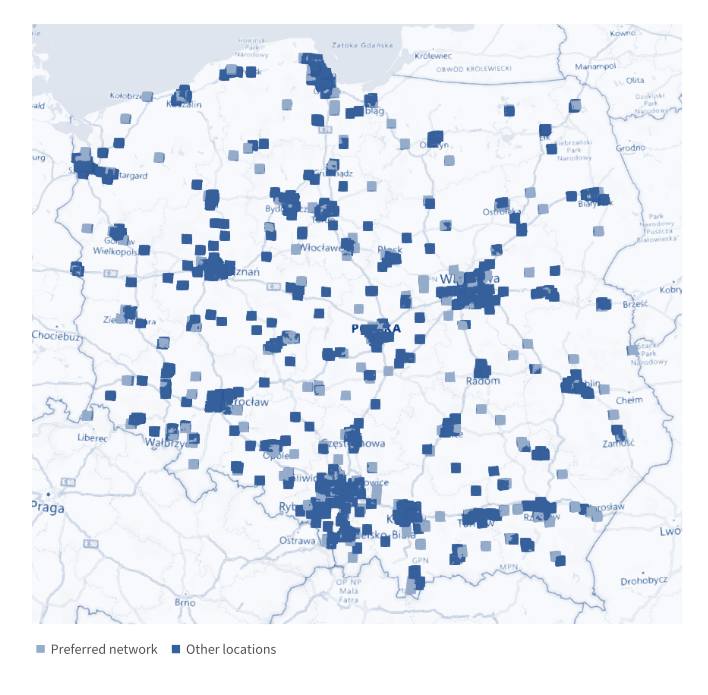
At the end of 2025, the network included about 900 entities in 1,400 locations, providing high coverage of the territory of Poland. About 80% of the shops are authorized service centers, guaranteeing repairs in compliance with manufacturers’ standards, including the use of original parts. The rest are independent shops, which allow for optimization of repair costs while maintaining the required quality standards.
A total of 75–80% of the motor vehicle claims handled by PZU are dealt with in its own network. The network of repair shops remains a key component of the PZU Group’s strategy for efficient claims handling and ensuring a high level of customer satisfaction.

There is a preferred group within the network, comprising about 300 facilities that perform about 20% of all repairs. These repair shops are covered by extended terms of cooperation, guarantee the highest quality standards and cost optimization, and receive a higher volume of orders from PZU. The network structure is diversified – despite the important role of large dealer groups, the PZU Group is not dependent on a single supplier, which minimizes concentration risk and ensures operational stability.
The PZU Group is actively shaping service and repair quality standards in the network. Before cooperation is established, each shop undergoes a verification process that includes an evaluation of equipment, procedures and customer service conditions. Technical and process guidelines are implemented under the contracts, with PZU Assistance conducting regular (both scheduled and unannounced) inspections, as well as quality audits. Several hundred inspections were carried out in 2025, keeping the irregularities in the own network at the low level of few per cents.
An important element of the quality system is the Repair Quality Certificate, which is issued by the repair shops operating in the network. This document confirms the compliance of the repair with the PZU Group’s standards and is the basis for handling potential complaints. If the customers has any objections, PZU Pomoc acts as an arbitrator, ensuring that the repair is rectified at the same or another repair shop, which reinforces trust and transparency in the process.