

PZU’s risk map results from the nature of its business and the PZU Group’s strategy and business plans; it is subject to periodical monitoring and control. Given the scale of insurance operations by the PZU Group companies and the amount of funds earmarked for investment, the most significant risks are underwriting risk, market risk and the risk associated with the activity of undertakings operating in other financial sectors. In the last item, credit risk is the most important.
In compliance with the applicable provisions of the Solvency II, the PZU Group calculates its consolidated solvency capital requirement (SCR) reflecting the value of eligible own funds that would enable the PZU Group to cover significant unforeseen losses which may occur with a probability of 0.5% within one year. As such, SCR means a loss that may occur in a worst-case scenario with a probability of once in 200 years.
SCR is to ensure sufficient degree of protection of the interests of the insured. PZU Group’s SCR is calculated on the basis of the standard formula according to the Solvency II and includes the following risks: underwriting risk, counterparty insolvency risk, operational risk and the adjustment related to the capacity of deferred income tax to cover losses.
The Basic Solvency Capital Requirement (BSCR) before diversification at the end of Q3 20251 amounted to PLN 14.8 billion, and the SCR stood at PLN 14.1 billion.
The risk profile, understood as the relative contribution of individual risk modules, did not materially change. Over the first nine months of 2025, the SCR increased by 7%. The elevated growth dynamics were driven primarily by higher GDP growth, expanding business volumes, higher interest rates and moderate inflation.
1 The report on the solvency and financial condition of the PZU Group for 2025 will be published on the PZU website in the Investor Relations section at the turn of April and May 2026.
- Non-life underwriting risk (+PLN 0.41 billion before diversification and +PLN 0.30 billion after diversification; +6%) – the increase resulted from higher premium volumes (PAA revenues under IFRS +7%) and higher catastrophe risk linked to rising sums insured and the effects of the previous year’s floods. Natural catastrophe risk was partly mitigated through reinsurance.
- Market risk (+PLN 0.23 billion; +5.6%) – the increase in equity and spread risk reflects the pursuit of higher returns in an environment of declining government bond yields, including through additional exposure to Polish corporate debt instruments, purchases of government securities denominated in currencies other than the currency of issue, and selective investments in investment funds and equities. Moreover, capital charges for equities increased due to the Solvency II symmetric adjustment mechanism. At the same time, purchases of non-PLN denominated securities and the appreciation of the złoty contributed to a reduction in currency risk (narrowing of the Solvency II FX gap).
- Life underwriting risk (+PLN 0.13 billion; +5%) – the business remained stable, although growth dynamics were slightly lower. The rise in lapse risk resulted from improved profitability of individual products. Changes in calculation methodology also had an impact.
Banks (change in requirement attributable to PZU: +PLN 0.25 billion, +9%) – this is the effect of regulatory changes (CCR) at the beginning of the year, which increased Alior Bank’s capital requirement by PLN 0.2 billion (+15%) and at the same time reduced the requirement for Bank Pekao (mainly in the area of operational risk) by PLN 0.05 billion (-2%). Furthermore, the dynamics of changes in capital requirements in banks was similar to that observed in the insurance segment.
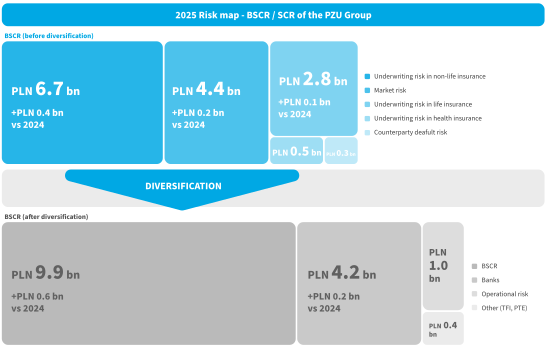
* As at 30.09.2025
| The most significant risks facing the PZU Group and management actions | |||
|---|---|---|---|
| Most significant risks of the PZU Group | Risk sub-modules | Definition | Management actions to mitigate the risk |
| Underwriting risk in non-life insurance | Premium and provisioning risk | The possibility of loss or adverse change in the value of insurance liabilities:
|
Underwriting risk mitigation in non-life insurance is carried out in particular through the following activities:
In the area of premium and provisioning risk, the following actions are carried out:
In the area of catastrophic risk, the following actions are carried out:
|
| Catastrophic risk | Catastrophic risk – the risk of loss, or of adverse change in the value of insurance liabilities, resulting from the significant uncertainty of pricing and technical provisioning assumptions related to extreme or irregular events. | ||
| Lapse risk | The risk of loss or adverse change in the value of insurance liabilities, resulting from changes, trends or volatility of the lapse rates, policy lapses, redemptions and renewals. | ||
| Market risk | Interest rate risk | The possibility of incurring a loss as a result of changes in the value of financial instruments or assets and a change in the present value of projected cash flows from liabilities, caused by changes in the term structure of market rates or in the volatility of risk-free market interest rates. | Management actions in respect of market risk involve in particular:
The setting of limits is the main management tool for maintaining risk positions within acceptable risk tolerance levels. The structure of limits for the various categories of market risk and also for the various business units is established in such a manner that the limits are consistent with the risk profile and risk tolerance set by the management of each unit. |
| Equity risk | The possibility of incurring loss as a result of changes in the values of assets, liabilities and financial instruments caused by changes in the level or in the volatility of market prices of equities. | ||
| Credit spread risk | The sensitivity of the values of assets, liabilities and financial instruments to changes in the level or in the volatility of credit spreads over the risk-free interest rate term structure. | ||
| Foreign exchange risk | The possibility of incurring loss as a result of changes in the value of assets, liabilities and financial instruments, caused by changes in the level or in the volatility of currency exchange rates. | ||
| Property risk | The possibility of incurring loss as a result of changes in the values of assets, liabilities and financial instruments caused by changes in the level or in the volatility of market prices of property. | ||
| Asset concentration risk | The possibility of incurring loss stemming either from lack of diversification in the asset portfolio or from large exposure to default risk by a single issuer of securities or a group of related issuers. | ||
| Underwriting risk in life insurance | Mortality risk | The risk of loss or of adverse change in the value of insurance liabilities resulting from changes in the level of mortality rates, where an increase in mortality rates leads to an increase in the value of insurance company’s liabilities. | Underwriting risk mitigation in life insurance is carried out in particular through the following activities:
|
| Longevity risk | The risk of loss or of adverse change in the value of insurance liabilities, resulting from changes in the level of mortality rates, where a decrease in a mortality rate leads to an increase in the value of insurance company’s liabilities. | ||
| Risk of incapacity – morbidity |
The risk of loss or adverse change in the value of insurance liabilities, resulting from changes in the level of disability, bodily injury and morbidity rates. |
||
| Lapse risk | The risk of loss or adverse change in the value of insurance liabilities, resulting from changes in the level of policy lapses, terminations, renewals and surrenders. | ||
| Expense risk | The risk of loss or adverse change in the value of insurance liabilities, resulting from changes in the level, trend, or volatility of the expenses incurred in servicing insurance or reinsurance contracts. | ||
| Catastrophic risk | The risk of loss or adverse change in the value of insurance liabilities, resulting from the significant uncertainty of pricing and provisioning assumptions related to extreme or irregular events. | ||
| Operational risk | Security risk | The risk of incurring a loss due to ineffective or erroneous solutions to protect the Company’s operations from harmful human actions or external factors, as well as actions constituting an abuse of the law; this includes IT security risk, understood as the risk arising from non-compliance (deviations) with the Company’s policies, external regulations, procedures, standards and good practices in the field of IT security. | Management actions involving reactions to any identified and assessed operational risks involve, in particular:
|
| Legal risk | The risk of incurring a loss resulting from actions that are inconsistent with applicable laws, internal regulations or contractual obligations, which may also arise as a result of erroneous, late adoption or non-adoption of legal regulations and erroneous interpretation of regulations. | ||
| Personnel risk | The risk of incurring a loss resulting from inadequate and ineffective personnel policies, lack of adequate human resources, human errors including improperly designed and implemented processes. | ||
| IT risk | The risk of incurring a loss due to information technology that does not meet business requirements for reliability and data availability at the level assumed by the Company, or has not been properly implemented and is not operating as intended. | ||
| Underwriting risk in health insurance | – | – | The process of managing underwriting risk in health insurance is analogous to the risk management processes in non-life insurance and in life insurance, depending on the nature of health insurance. Sales of health insurance products was not assigned to a separate distribution channel and is handled by separate sales networks of non-life and life insurance companies. In view of separate management models for health insurance products in non-life and life insurance companies and slight underwriting risk of health insurance, no separate risk management systems were distinguished for health insurance. Products similar in their properties to life insurance products are managed as life insurance, whereas other ones are managed as non-life insurance. |
| Credit risk |
Counterparty default risk | The possibility of incurring a loss as a result of unexpected default of PZU Group’s counterparties and debtors or deterioration of their credit rating. | Management actions in respect of credit risk in the insurance part of the PZU Group involve in particular:
To mitigate credit risk, the banks in the PZU Group apply such restrictions as:
|
| Banks | Risk of loss or of adverse change in the financial situation, to which the PZU Group is exposed, resulting from fluctuations in the trustworthiness and creditworthiness of issuers of securities, counterparties and any debtors. | ||
