

In UE countries in 2023, outlays on health care, defined as health services and prevention were estimated at 10% of GDP, compared with 8.9% in 2022.
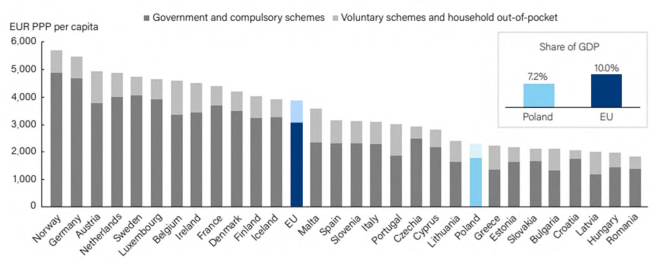
Average health expenditures in UE countries per capita, by purchasing power parity, reached EUR 3,832 in 2023. Of this amount, 80% came from public sources and 20% was private spending. Norway spent the most on health care, Romania the least.
Healthcare spending per capita in Poland is at EUR 2,266, equivalent to 7.2% of GDP, and remains below the European Union average of 10% despite growth. Compared with countries belonging to the European Union, healthcare expenditure in Poland is among the lowest and exceeds per capita spending only in Greece, Estonia, Slovakia, Bulgaria, Croatia, Latvia, Hungary, and Romania.

The share of public financing in healthcare in Poland has been steadily increasing, and in 2023 it reached 77.8%, private household spending accounted for 15.7%, voluntary health insurance accounted for 6.5% of total healthcare spending.
In 2023, 37.2% of current healthcare spending is allocated to hospital services, compared to an EU average of 27.7%. Outpatient services accounted for 30.5%, which was also higher than the EU average of 27.6%. Spending on pharmaceuticals was 17.3%, close to the EU average of 18.4%. 7.8% of expenditures, less than half the EU average of 18.1%, were for long-term care, confirming the limited availability of formal services in this area. Spending on prevention also remained low, at 1.7% in 2023, compared to the EU average of 4%.

According to the OECD report, in 2023 Poland's rate of practicing physicians per 1,000 citizens was 3.9 against an average of 4.3 for the EU as a whole, and a rate of nurses of 5.9 per 1,000 population against an average of 8.5 per 1,000 across the European Union. Shortages of healthcare workers in certain specialties and regions persist, particularly in smaller counties surrounding large cities and in rural areas.
Poland has one of the lowest ratios of general practitioners/family physicians – 6.7% in 2023 compared to the total number of physicians in the EU – 19.9%, indicating incomplete implementation of a primary care model based on family medicine and the substitution of primary care services for those of internists and pediatricians. In addition, 20% of physicians are aged 55–64 years old, and 30% of nurses are aged 50–59, raising concerns about the long-term availability of health services.
The number of hospital beds in Poland in 2023 was 6.3 per 1,000 residents, higher than the EU average of 5.1. Initiatives under the National Recovery and Resilience Plan aim to balance the overall capacity of hospitals and convert some of the surplus intensive care beds into long-term care beds, among other things.
Note: The EU average is a weighted average (calculated by the OECD)
Sources: OECD Data Explorer (DF_SHA); Eurostat (demo_gind); data refers to 2023
Mortality from treatable causes in Poland in 2022 remained above the EU average: the rate was 140 per 100,000 population, compared to the EU average of 90. The leading causes of death were ischemic heart disease (20%), pneumonia (14%), colorectal cancer (13%), stroke (11%) and breast cancer (8%). The high mortality rates are due to delayed diagnosis, limited access to primary healthcare and diagnostic tests, and shortages of medical personnel. The reforms envisioned in the RRP aim to improve access to oncology and cardiac care and standardize care within primary care.
The unfavorable trend in vaccination uptake continued in 2023, although the percentage of vaccinated infants against measles reached 91.8%, compared to 85.6% in 2021, it still remained below the EU average of 92.6% and the population threshold for measles elimination – 95%. The free HPV vaccine in 2024 was extended to boys and girls aged 9–14; in 2023, only 13% of children in this age group were vaccinated.

Adequate policies are needed to promote healthy living by prioritizing disease prevention, including through immunizations, supporting mental health at all ages and enabling people to manage their own health. The costs of inaction – both in terms of reduced healthy life years and economic burden – are too high. Projection models indicate that a coordinated “healthy aging” scenario could slow the growth of health care spending as a percentage of GDP in the coming decades and help contain long-term care costs while reducing the need for health and long-term care workers3.
The health care market in Poland

Estimated healthcare expenditures in Poland amounted to more than PLN 300 billion in 2024, of which a third is for private healthcare services, and the rest is financed by the National Health Fund, particularly in the segments of hospital care, outpatient specialist care services, and primary health care services.
According to PMR Market Experts, a market research and analysis firm in Central and Eastern Europe, the estimated value of the private healthcare market in 2024 approached PLN 90 billion, growing by double digits, with FFS products accounting for the largest share among medical services, nearly a third.
As of mid-2023, the National Health Fund increased valuations of services in specialized outpatient care. This has a positive effect on medical centers offering healthcare services under public financing. According to PMR Market Experts, medical inflation is still an important factor affecting the value of the private healthcare care market. The apparent trend of rising including grocery stores, gas stations, drugstores, herbalists, herbal and medical stores, prices from 2022 onward will also continue in the years to come, and the above aspects will be particularly important for the prices of outpatient and physician services. The healthcare services market (fee for service, subscriptions, insurance) is sensitive to marked increases in the price of electricity and materials and raw materials, which raise operating costs.
In 2024, the growth rate for remunerations in private health care was as high as 9.4% y/y, which was mainly due to remuneration claims of white staff including physicians, nurses, physical therapists, physiotherapists, hygienists and dental assistants (which was a rate close to the forecasted for this year, being 9.3%).
The number of supplemental health insurance holders is growing every year. The vast majority of people holding these products are group policyholders, although there has been an increase in interest in individual policies since the outbreak of the pandemic. At the end of 2024, the number of people in Poland with private health insurance amounted to about 5.39 million, an increase of 12% y/y. In the course of this period, Poles spent nearly PLN 2.309 billion on private policies, up nearly 35.3% y/y. However, this represented only 2.7% of the total Polish insurance market and 22% of the private health care subscription market, which was worth a total of PLN 10.5 billion.
PMR Market Experts forecast that the total value of the private healthcare market will grow at a high single-digit rate in 2025. Poland is still one of the European Union countries with a relatively low level of spending on healthcare, both per capita and in relation to GDP. Nevertheless, the private medical services segment is growing steadily. According to analysis by PMR Market Experts, its value – excluding drugs and paramedical products – will grow at an average annual rate of 7.6% until 2030.
In addition, the following is expected:
- further intensive development of telemedicine and service opportunities through remote channels;
- increasing number of persons outside working age and greater need to provide care to senior citizens;
- increasing public awareness of prevention and periodic examinations;
- persistently high inflation of medical services, in particular due to wage pressures from medical staff;
- increased interest in apps, platforms and digital solutions for prevention, health monitoring and therapy.
PZU Zdrowie (Health Pillar in the PZU Group) is the leader of the health insurance market in Poland and remains among the largest companies in the overall private health care market, where the main competitors are the LUX MED Group and Medicover. In terms of the value of the Health Pillar’s revenues, the PZU Group ranks third among nationwide medical operators with revenues at PLN 1.9 billion in 2024, an increase of 18.1% y/y.
3. OECD “Health at a Glance 2024” Report, Health at a Glance: Europe 2024 – European Commission
4. The “medicine and non-medicine expenses” category includes: (1) patient spending on medicines (reimbursed, non-reimbursed Rx and OTC), dietary supplements and other products in pharmacies, and (2) patient spending on OTC medicines and dietary supplements outside of pharmacies (in convenience stores, including grocery stores, gas stations, drugstores, herbalists, herbal and medical stores, specialized supplement stores, sporting goods stores and others), including online sales in e-stores (including e-pharmacies) and sales platforms
